






Sundarbans Mangroves in Danger
8 May 2012
Mangroves anchor the edges of the world, but they are slipping away, thanks to coastal development, pollution, over-harvesting, nutrient loading, overuse of freshwater, and climate change.
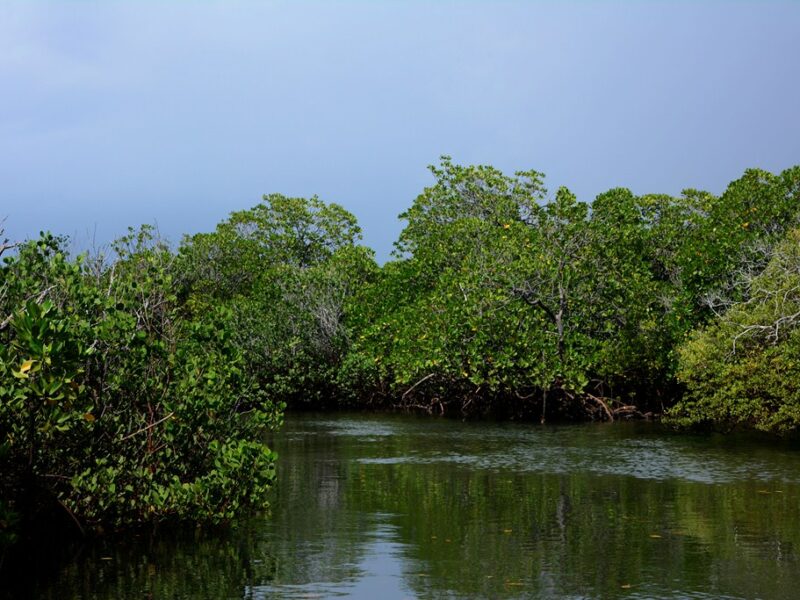
The world’s largest intact halophytic (salt-tolerating) mangrove forest is the Sundarbans, a UNESCO World Heritage Site that straddles India and Bangladesh. It forms the transition zone between the Ganges and the Bay of Bengal, and is a stronghold for the endangered Bengal tiger, as well as many other species, from monkeys to crocodiles.
However, as a recent report by Dr. Md. Mizanur Rahman warns, these mangroves are in trouble. They face rising temperature, rising seas, silt and pollution washing down from deforested areas in the Himalaya, and pressures from aquaculture activities around the Sundarbans.
They are also being assaulted by rising salinity, brought by the formerly fresh rivers and streams that feed them. As agriculture increases in the region, water levels drop, minerals accumulate, and salinity rises. Brackish water is also expanding underground.
The fate of the Sundarbans mangroves lies both in how they can be protected locally, and in the health of the whole Ganges system. What happens upstream affects what comes down the pike.
Read full article
Scholarships Open for IWC Water Leadership Program
18 April 2012
Scholarships for the 2012/13 round of the IWC Water Leadership Program are now open. Applications can be made online until 30 June 2012. The next program will begin in December 2012.
Designed for emerging water leaders at the project to middle management level, this program is customised for the water sector through sound research and collaboration with experienced industry practitioners.
The program helps emerging leaders to develop the abilities they need to exert influence, drive change and advance challenging integrated water managementprojects — abilities associated with the most effective integrated water management leaders.
Several full ($10,000), half ($5,000) and quarter ($2,500) merit-based scholarships are available in 2012. Scholarships are currently only available to Australian citizens and permanent residents of Australia.
Charles River Celebrates with Partners
10 April 2012
The Charles River Watershed Association (CRWA), winners of the 2011 Thiess International Riverprize, recently thanked all of their partners who assisted with the clean-up of the Charles River. At a celebration on 22 March at the Cambridge Boat Club, IRF Board member Peter Krause delivered a speech and presented certificates to over 25 partner organisations who contributed to the 20 year river restoration project.
"Restoring America's rivers, especially in urban areas, has been a priority for the Obama administration and a focus of our efforts to strengthen American communities. The Charles River is a great example of how the health of waters that run through our communities is closely tied to the health of the people and the economies in the area," said EPA Deputy Administrator Bob Perciasepe, who attended the event.
"We're proud to have worked with so many dedicated people and organizations that have over the years transformed the Charles from one of the dirtiest rivers in America to one of the cleanest, and we're thankful that this work has been recognized by the International RiverFoundation."
European Riverprize Announced!
2 March 2012
The International RiverFoundation and the International Commission for the Protection of the Danube River (ICPDR) are working together to establish a European Riverprize - the first of which will be awarded in 2013.
On 27 February 2012, IRF CEO Matthew Reddy and ICPDR President Wolfgang Stalzer signed a Memorandum of Understanding to cooperate in programmes that promote and strengthen efforts towards sustainable river basin management in Europe and throughout the world. The establishment of a European Riverprize is one of the key elements of this partnership, and is an exciting development for the IRF and its networks - especially those based in Europe.
The signing of ther MoU took place at the ICPDR secretariat in Vienna, Austria, and representatives of the European Centre for River Restoration, GEF IW Learn and the Thames River (2012 Riverprize winner) also attended the ceremony and joined in discussions around the European Riverprize.
ICPDR Website
CIWEM holds International Water Management Conference in Europe
19 March 2012
Congratulations to the CIWEM team for successfully hosting the Water Management in Europe event in Lille, France, last month and on creating a collegiate milieu in which provocative questions could be asked and ideas challenged freely among the delegates.
The objective of the conference was to explore the key challenges facing European countries today, and to share experiences and gain feedback on practical solutions and research on key topics. These key topics included water security, flood risk management, water quality, sustainability, river restoration and the Water Framework Directive.
Presentations may be accessed on the CIWEM site.
Play Online Catchment Management Game
23 February 2012
'Catchment Detox' is an online game where you're in charge of the whole catchment. You decide what activities you undertake - whether it's planting crops, farming livestock, regenerating bushland, building factories or setting up national parks. The aim is to avoid environmental problems and provide food and wealth for the population. Just like real life, you'll need to manage unexpected rainfall or other environmental challenges, and maintain a healthy balance that supports the economy as well as the environment.
Catchment Detox is based on a model developed by CSIRO Division of Land and Water and e-Water CRC. It is based on the latest scientific understanding of water and catchment issues, and the catchment you manage is a made up catchment which is based in Australia and experiences a highly variable rainfall regime.
To play Catchment Detox and test your understanding of catchment management, visit www.catchmentdetox.net.au.
Thames-Ganges Twinning Launch a Success
16 January 2012
The Thames and Ganges Twinning Programme held an event in New Delhi in December to mark its official launch. The event was hosted by WWF India in the auditorium of their office in New Delhi, and was attended by a wide range of stakeholder organisations and interested people, including Dr Rita Sharma, Senior Adviser, Science and Innovation at the British High Commission in New Delhi.
The event included guest speakers Dr Siddarth Kaul, Advisor to the Ministry of Environment and Forests of the Government of India, and Dr Sejah Woral, Programmes Director of WWF India. The keynote speech was given by Dr Peter Spillett, a board member of the Thames Rivers Restoration Trust and President of the Institute of Fisheries Management in the UK. Following the presentations, a question and answer session was held between the audience and the speakers. This session touched on many of the pressing issues around the sustainable management of rivers and water resources in India and the UK.
While in India, Dr Peter Spillett and Robert Oates, Executive Director of TRRT, visited several areas of Twinning Programme activity. On the upper Ganges they helped to release seventy five young Gharial crocodiles into the river as part of a reintroduction programme for this highly endangered species by WWF India. On the lower Yamuna tributary they named a new project boat ‘Thamesis’ after the ancient goddess of the River Thames. And on the upper Yamuna they participated in a natural farming workshop for representatives from twenty villages in the Programme. At the workshop they presented solar cookers and lamps for trial by the villagers. They also presented certificates to pupils who had planted native trees in school grounds. On their tour they gave several interviews to local press, radio and TV stations.
Sunshine Coast Rivers Initiative Partners Awarded
17 November 2011
The Sunshine Coast Council hosted a celebratory river cruise as a way to thank all of the partner organisations involved with the Sunshine Coast Rivers Initiative - the winners of our 2011 National Riverprize.
Thirty partner organisations were invited on the three hour cruise up the Noosa River, and this was great opportunity for everybody to celebrate the success of the project and get together to talk about the next steps, including potential 'twinning' partners. Steve Skull, Manager of Environmental Policy and Programs at the Sunshine Coast Regional Council, said that it was important for partners to think about how to best invest the prize money to ensure longevity with the Sunshine Coast Rivers Initiative, so that the project continues to grow and develop.
The International Riverfoundation was also able to take this opportunity to present representatives from each of the partner organisations with certificates acknowledging their Riverprize success.
Siuslaw Basin & Sakhalin Island Twinning Update
16 November 2011
Oregon's Siuslaw Basin Partnership, winners of the Thiess International Riverprize in 2004, has been twinning with Russia’s Sakhalin Island, sharing knowledge in sustainable salmon and river management in partnership with the Wild Salmon Center. Significant achievements have resulted from this partnership such as establishing Russia’s first watershed council and the Sakhalin Salmon Initiative. In October, the Wild Salmon Center and Siuslaw Institute hosted the third Oregon-Russia Far East Watershed Council Exchange.
The primary goal of the exchange was to provide representatives from the Public Salmon Councils in the Russian Far East with an opportunity to learn from well-established, successful models of citizen involvement in local watershed management that have been developed in Oregon through its watershed council network. While visiting the Siuslaw Basin, Russian delegates met with government agencies, the Siuslaw Watershed Council, indigenous representatives, school youth and educators, as well as rivers practitioners. Johnny Sundstrom, founder of the Siuslaw Institute said:
“Our success in previous exchanges has shown us how important it is to share direct knowledge and experience of a place with the people who can best learn and apply these lessons in their homeland. The continued development of this unique relationship-building, and the ongoing accumulation of understanding and expertise that comes from international cooperation, truly benefits all of the parties involved in both tangible and intangible ways”.
Tweed-Kenya Mentoring Program Update
16 November 2011
The Tweed-Kenya Mentoring Program (TKMP) commenced in 2003 and has evolved into a dynamic partnership built on transferring technical and cultural knowledge between Australian and Kenyan individuals and communities. TKMP’s urban projects work with youths and community groups within the informal settlements of Nairobi to improve the environment and rehabilitate the Nairobi River. Emerging out of the urban activities are: a youth network of over 100 clubs called Youth-Community Led Environmental Action Network (YCLEAN); six primary schools with indigenous tree gardens; catchment re-vegetation and riparian care –where more than 10000 seedlings have been planted since 2008; and an annual environmental advocacy soccer tournament called the Great Nairobi River Tournament.
In rural Kenya, TKMP’s SafeWater Program commenced in 2007 with the installation of ‘Sky Juice’ water filtration systems to improve water access in rural areas. Increasing access to safe water in rural Kenyan communities has increased community health by reducing exposure to diseases such as typhoid and cholera, as well as reducing the time taken to collect clean water. In September, Mr David Mango, Safewater Manager, visited the Tweed community to learn more about river and water management and the implementation of community based conservation projects. Mr Mango also attended in the International Riversymposium, networking with other practitioners and learning more about river management from Australian and international participants. Safewater will be delivered in the Siaya District, Western Kenya by Tweed Shire Staff member Nigel Dobson in early 2012.